Anxiety and the Nervous System — Where Complementary Therapy Fits
Ask most people whether they have anxiety and they will say no.
Then they will tell you they cannot sleep. That their shoulders are always tight. That they feel snappy and depleted and cannot seem to switch off at night even when nothing is actually wrong. That they are tired in a way that a good night's sleep — on the rare occasion they have one — does not fix.
They do not call it anxiety. They call it being busy. They call it just life.
I understand why. Anxiety conjures a specific image — the racing heart, the panic attack, the person who cannot leave the house. And for some people, that is exactly what it is. But for the majority of clients I see in clinic, anxiety looks much quieter than that. It looks like a person who is coping, mostly. Functioning, just about. Getting through. Never quite landing.
This post is for that person — and for anyone who wants to understand what is actually happening in their body when they feel that way, and what complementary therapy can genuinely do to help.
Why You Feel the Way You Feel
Your nervous system is not dramatic. It is not overreacting. It is doing exactly what it was built to do — protecting you.
The problem is that it cannot always tell the difference between a genuine emergency and a very full inbox. A difficult conversation, a mounting to-do list, a child who will not sleep, a deadline that keeps moving — to your nervous system, these register as threat. And when threat is present, it responds. Every time.
It floods your body with adrenaline and cortisol. It tenses your muscles, shallows your breathing, and sharpens your attention. It puts your digestion on hold and keeps your brain in problem-solving mode. This is the sympathetic nervous system — your accelerator — and when it kicks in, it is genuinely useful. In short bursts.
The issue for most people living with anxiety or chronic stress is that the accelerator never fully releases. The threats are real, but they are relentless and low-grade, and they never fully resolve. So the body stays braced. Day after day, week after week, sometimes year after year.
The parasympathetic nervous system — your brake — is what brings you back. It is sometimes called the "rest and digest" state, and it is the place where your body heals, restores, and regulates properly. Your heart rate slows. Your muscles release. Your digestion works. You can take a full breath. You feel, at some basic level, safe.
Most of the people I see have not spent very much time there recently.
What It Actually Feels Like
Anxiety does not always feel like panic. That is the version most people picture — the racing heart, the shortness of breath, the sense of dread. And yes, it can be that.
But more often, in the clients I work with, it is quieter than that. It is the tension across the shoulders that is there before you are even out of bed. The jaw you have been clenching without realising. The headache that arrives every afternoon like clockwork. The feeling of being tired in a way that sleep does not fix. The sense that you are permanently one thing away from tipping over.
It is lying awake running through the same lists at midnight, knowing none of them are urgent, unable to stop anyway. It is snapping at someone you love and not understanding where that came from. It is feeling strangely flat or disconnected even when nothing is technically wrong.
These are not personality traits. They are not weaknesses. They are the physical and emotional signature of a nervous system that has been overloaded and under-restored for too long.
And here is something that surprises many people: anxiety does not only live in the mind. It lives in the body. In the tension, the held breath, the braced posture, the tight gut. The body and the nervous system are in constant conversation — and importantly, that conversation runs both ways. Just as stress creates physical tension, releasing physical tension sends a signal of safety back to the brain.
This is why hands-on therapy can reach something that thinking your way through anxiety sometimes cannot.
Where Complementary Therapy Fits
I want to be honest about what complementary therapy is and is not. It is not a cure for anxiety, and I will never pretend otherwise. If you are struggling seriously, please do also talk to your GP or a mental health professional. There is no hierarchy here — good support is good support, wherever it comes from.
It is also worth saying something about the word complementary, because it is often used interchangeably with alternative — and they are not the same thing. Complementary therapies are ones that work alongside conventional, allopathic, or mainstream medical care. They sit beside your GP, your medication, your physiotherapist, your counsellor — not instead of them. An alternative therapy, by contrast, is something pursued outside of or to the exclusion of general medical advice. That is not what this is. If you are under medical care, these treatments work with that, not against it.
What complementary therapy offers, consistently and reliably, is this: a way to bring the nervous system out of high alert and back into balance. A way to give the body the signal it has been waiting for. A way to interrupt the cycle, even briefly, so that something else becomes possible.
Here is how the therapies I offer do that in practice.
Massage
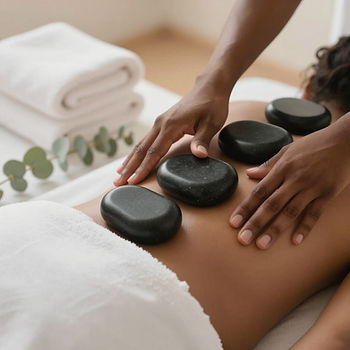
The most common thing I hear after a massage from a client who came in wound up and wary is some version of: I did not realise how much I was holding.
Touch is one of the most direct ways to communicate safety to a nervous system that has forgotten what safe feels like. It stimulates the vagus nerve — the primary pathway of the parasympathetic system — and triggers a measurable reduction in cortisol, the stress hormone, alongside an increase in serotonin and dopamine. None of that is woo. It is physiology.
For someone who has been carrying tension in their body for months or years, the release that happens on the treatment table can feel genuinely extraordinary. Not because the massage is doing something magic, but because it is giving the body permission to do what it has been trying to do all along — let go.
Depending on what you need, that might be a deeply relaxing treatment that invites the whole system into a slower, softer state, or a deeper tissue treatment that works through layers of physical holding that have built up over time. Both have their place. We figure out together which one is right for you.
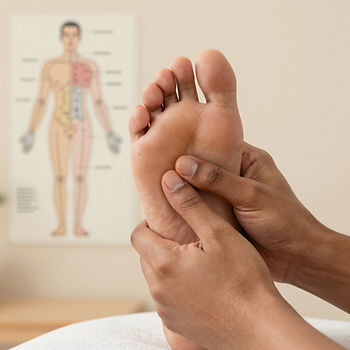
Reflexology
Reflexology is one of those treatments that is quite difficult to describe and quite easy to experience.
The technique works with reflex points on the feet that correspond to every system and organ in the body. The pressure is precise and relatively light, and for most people it is profoundly relaxing in a way that feels different from other treatments — a quality of deep, spreading rest that some clients describe as unlike anything else they have felt.
From a nervous system perspective, reflexology supports circulation, encourages the endocrine system — which governs the stress hormones that keep you on edge — and creates that genuine parasympathetic rest that is so hard to access when you are living inside a busy, pressured life.
Sometimes people may become emotional on the couch during their treatments. Not from pain, and not because anything is wrong. It is release — the kind the body has been holding back because there was never a moment quiet enough to let it through. I do not find it strange or uncomfortable. I find it one of the most honest and moving things that can happen in a treatment room.

Aromatherapy
Scent has a faster route to the brain than almost anything else. When you inhale an essential oil, the molecules reach the olfactory receptors within moments and trigger a neurological response that can shift both your emotional state and your physical one. This is not metaphor. It is anatomy.
Essential oils such as lavender, bergamot, frankincense, and clary sage are well documented for their calming properties — their ability to reduce physiological markers of stress and support the kind of nervous system balance we are working toward.
What I love about aromatherapy is how personal it is. Every blend I create is made for the person in front of me — not a generic calming blend off a shelf, but something chosen for your specific presentation, your specific needs, and yes, the scents that you are actually drawn to. Because if a smell makes you tense, it is not going to help you relax, regardless of what the research says.
Many clients take a blend home to use between appointments — a roller ball, a diffuser blend, something to reach for in the moments when anxiety rises and they need a way back to themselves.

Indian Head Massage
If you carry your anxiety in your head, neck, and shoulders — and most people do — this treatment tends to feel almost painfully targeted in the best possible way.
The tension that accumulates in the scalp, the base of the skull, the trapezius muscles, and the jaw is not just uncomfortable. It contributes to headaches, difficulty concentrating, disrupted sleep, and that specific kind of exhaustion that comes from holding yourself physically rigid all day without noticing you are doing it.
Indian head massage works precisely this area. It releases held muscle tension, improves circulation to the brain, and delivers the kind of focused, attentive touch that says — at a body level, beneath words — you can put it down now. Many clients fall into a deep, involuntary relaxation partway through and emerge looking and feeling noticeably different from how they arrived.

Reiki
I understand that reiki is not for everyone, and I say that without judgement. But I also want to mention it, because for some clients it offers something quite distinct.
Reiki is a gentle, non-invasive energy treatment. There is no manipulation, no pressure, no disrobing. What it tends to produce — consistently, across clients who came in sceptical and clients who came in open — is stillness. A quality of deep, settling quiet that can be very hard to find any other way.
Many clients enter a state during reiki that sits somewhere between wakefulness and sleep — the theta brainwave state that the body accesses in deep rest and meditation, and that most anxious people almost never reach during ordinary life. It is the state in which the nervous system genuinely repairs and restores.
For someone who has not been still — not properly, quietly still — in a very long time, that experience can be unexpectedly powerful.

Soundbaths
The body responds to sound in ways that go beyond the conscious experience of hearing it. Specific frequencies — particularly those produced by Tibetan singing bowls — have been associated with measurable shifts into parasympathetic states, slower brainwave activity, and reduced cortisol response.
In a soundbath, you are asked to do nothing except lie still and receive. You do not need to concentrate or practice or get it right. The sound moves through you and the body responds, often in ways that clients find both surprising and deeply restorative.
People arrive at soundbaths carrying a lot. They leave differently — quieter, softer, a little more at home in themselves. It is one of the most accessible entry points into this kind of work, particularly for people who are not yet sure they are ready to lie on a treatment table.
The Thing I Want You to Take Away
Anxiety is not a character flaw. It is not something you should have sorted out by now. It is a physiological state — one that has been building, often for years, in a life that has asked a great deal of you and offered very little in the way of genuine rest.
Complementary therapy does not ask you to be anywhere other than where you are. It meets you in the body, in the moment, without judgement. It works with what is actually happening rather than asking you to think your way to a different feeling.
It is not instead of other support. It sits alongside everything else you are doing — or might one day do. It is the part of your care that says: you deserve to feel well. Not eventually. Now.
Come and Talk to Us
If any of this has resonated — if you recognise yourself somewhere in these pages — I would love to hear from you.
Treatments are available at ReCoop Health in Nuneaton, with evening and weekend appointments to work around the life you are actually living. If you cannot make it in person, I also offer digital nervous system reset programmes and guided practices through the My Daily Sanctuary app.
There is no wrong place to start. There is only starting.
BOOK A TREATMENT
EXPLORE DIGITAL RESOURCES
GET IN TOUCH