Reflexology — The Treatment Most People Overlook Until They Try It
If you have never had reflexology, there is a reasonable chance you have a mild, unexamined scepticism about it.
Maybe you associate it vaguely with something your aunt tried once, or a poster you saw in a health food shop with a diagram of a foot covered in tiny labelled zones. Maybe you assume it is pleasant enough but essentially decorative — the kind of thing you might try on a spa day but would not seek out for anything serious.
I understand that. And I would like to gently challenge it.
Because in fifteen years of clinical practice, reflexology has produced some of the most profound and consistent outcomes I have seen in the treatment room. Not occasionally. Routinely. And the clients who are often most surprised by this are the ones who arrived certain that their real problem was somewhere else entirely.
The Client Who Comes in for Their Neck
I want to tell you about a very common pattern, because I think it is the most honest way to explain what reflexology actually does.
Someone books with me because their neck and shoulders are in a state. The tension has been building for months, possibly years — tight trapezius muscles, that familiar ache across the tops of the shoulders, a neck that feels like it belongs to someone twice their age. They want deep tissue work. They want those knots releasing. They are, quite understandably, focused on the area that is causing them the most trouble.
And they are right to be. That tension is real, it is uncomfortable, and working directly on it matters. We will always address it. At Brookes Therapies we work on the back, neck, and shoulders, and we also always include the front of the body — the chest, throat, and décolletage — because if you have significant tension in the trapezius and neck, it is there in the front of the body too. Avoiding it would be like treating one side of a knot and leaving the other.
But here is what I find myself saying, quite often, to clients who are locked into that neck-and-shoulders focus: I think you also need deep relaxation. And massage, wonderful as it is, does not give you what reflexology gives you.
Most of them look at me a little uncertainly.
Most of them convert after the first session.
What Reflexology Actually Does

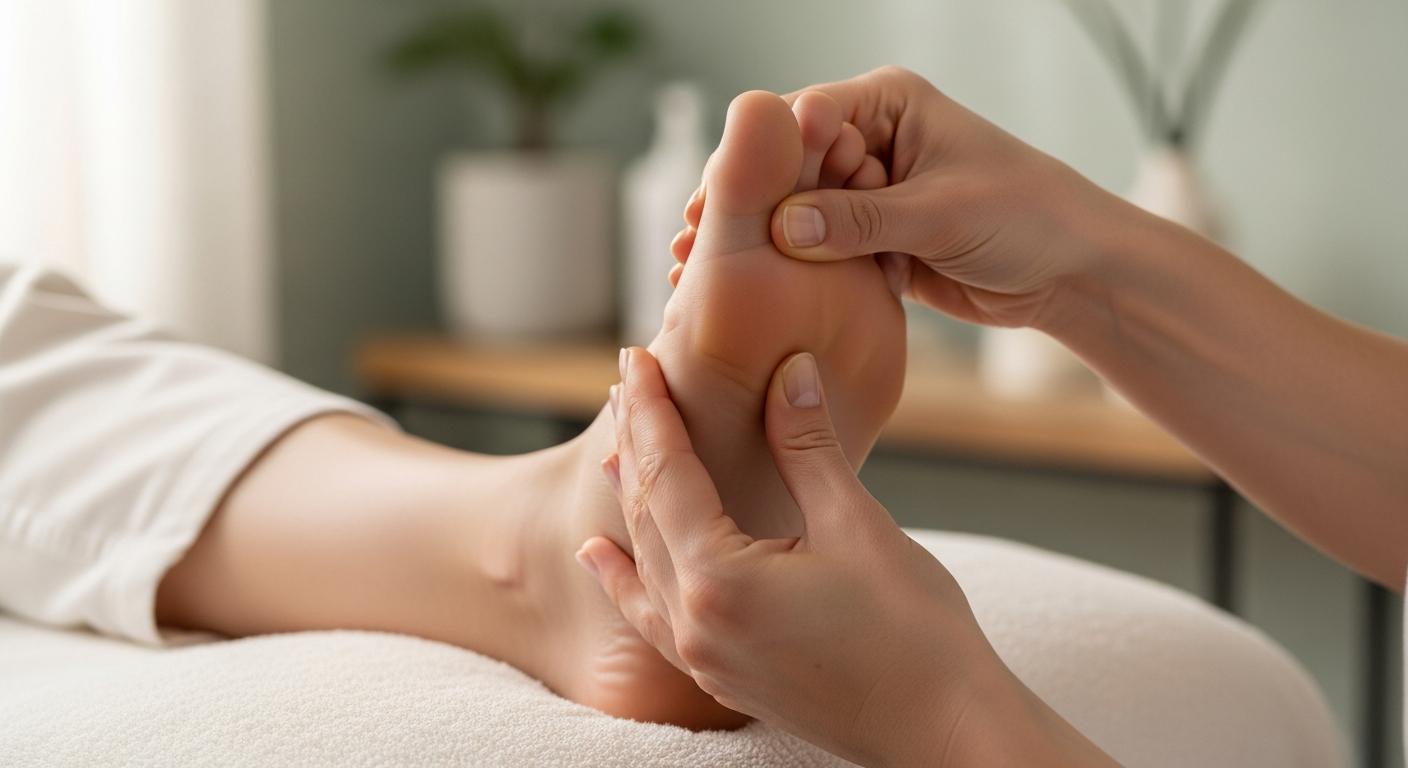
Reflexology works with specific reflex points on the feet — a detailed map that corresponds to every system, organ, and structure in the body. The technique is precise and the pressure is light, far lighter than most people expect. It does not feel like a foot massage, though it is deeply pleasant. It feels like something more focused and more deliberate than that.
What it produces, consistently and reliably, is a quality of relaxation that is genuinely different from what massage alone creates.
I want to be specific about that, because I think vagueness does reflexology a disservice. After a deep tissue treatment, the muscles have been worked, the tension addressed, the physical holding released. That is valuable and important. But the nervous system can still be running — still slightly activated, still processing. Adding even fifteen or twenty minutes of reflexology at the end of that treatment does something distinct: it drops the body into a deeper parasympathetic state. The kind of stillness that the nervous system has often been trying to reach and not quite managing.
Clients who have come in wound tightly and had a full back and shoulder treatment will often lie there during the reflexology portion and simply — let go. Completely. In a way they have not managed in the preceding forty minutes of hands-on work.
That is not magic. It is physiology. Reflexology supports circulation, encourages the endocrine system to settle, and speaks to the nervous system in a way that signals, at a deep level: you are safe. You can stop now.
The Combination Treatment — and Why It Works
One of the things I love most about the way we work at Brookes Therapies is that treatments are not fixed menus. They are built around you.
You might come in and say: my back, neck, and shoulders are the priority. Fine. We might spend forty minutes there, working deeply and thoroughly through the layers of tension that have accumulated. Then fifteen to twenty minutes of reflexology to close — not as a filler, not as an afterthought, but as the part of the treatment that completes the picture. The part that invites the body, after all that focused physical work, into genuine rest.
That combination is something I recommend frequently, and clients who experience it rarely want to go back to one without the other. The massage addresses the body's acute physical needs. The reflexology addresses the nervous system's deeper need to settle. Together they offer something more complete than either does alone.
If you are the kind of person who comes in saying I don't really need my feet touched, I need my shoulders sorted — I hear you. And I would ask you to try it once. Just once. Because almost without exception, that becomes the session where something shifts.
Who Reflexology Is For

This is one of the things I find most meaningful about reflexology as a treatment: the breadth of people it is genuinely suitable for.
Because the technique is so gentle, it is accessible in situations where other hands-on therapies are not. Elderly clients who find deeper bodywork uncomfortable, or whose skin or circulation requires a more careful approach, often respond beautifully to reflexology. It is suitable for people who are unwell, managing chronic conditions, or in a period of physical fragility — which is why reflexology, along with reiki, appears on the NICE guidelines for palliative care. That is the level of gentleness we are talking about. Gentle enough to be recommended for people at the most vulnerable point of their lives.
It is suitable for children — including anxious children, stressed children, children with additional needs who find other forms of touch overwhelming or difficult. It is suitable for pregnant women from the second trimester onwards. It is suitable for stressed adults, seniors, people recovering from illness, people who simply want to feel better and have not found the right route in yet.
The one honest caveat is this: reflexology works best for people who are comfortable with touch on the feet. If that is something you find genuinely difficult, we can talk about it and explore what else might suit you. But for the vast majority of people who try it, the feet turn out to be a surprisingly welcome and deeply relaxing place to receive treatment.
Learning to Give It
There is one more thing I want to say about reflexology, because this blog is not only for people looking for treatment. It is also for people who feel drawn to the work itself.
Reflexology is one of the most transferable skills you can learn. We offer it as a short course for people who want to add it to an existing therapy practice, and as a full Ofqual-regulated Level 3 Diploma for those who want to train to the highest standard and build a career around it. We also offer it in a simpler, non-accredited form for parents who want to use basic techniques safely at home with their children — because the calming and connecting power of this kind of touch does not require a diploma to be meaningful.
What reflexology teaches you, regardless of the level at which you learn it, is something about the profound responsiveness of the body. About how much can be communicated through careful, attentive touch. About how quickly and reliably a person can move from agitation to stillness when the right kind of contact is offered.
I have been practising reflexology for fifteen years. It still moves me when I watch someone's breathing change under my hands.
Ready to Try It?
If you have been curious about reflexology but not quite sure whether it is for you, the simplest thing is to book a session and find out. We can discuss what you are hoping for beforehand, and we will tailor the treatment to suit you — whether that is a standalone reflexology treatment, a combination with massage, or something else entirely designed around where you are right now.
Treatments are available at ReCoop Health in Nuneaton, with evening and weekend appointments. If you are interested in learning reflexology — for professional practice or for home use — get in touch and we can talk through the options.
BOOK A REFLEXOLOGY TREATMENT
FIND OUT ABOUT REFLEXOLOGY TRAINING
GET IN TOUCH